Gender Schemas: How Do You Raise Your Child In A Culture Defined By Gender?

ON NOVEMBER 8, 2019 BY ELIZABETH HERLIHY 

Image result for gender schema
freeimages.com

During early childhood (ages 3 to 8), children begin to develop schemas based on people they know. This means that they organize information they gather from people they see and associate certain people with various characteristics. One of the most important schemas children start to learn around the age of 3 involves gender. Children start to understand that there are societal expectations and interests that make boys and girls different. This association becomes very strict at first but over time they may come to see that boys and girls can like a lot of the same things. 

How Do Children Develop Their Gender Identity?

Image result for boy and girl toys
freeimages.com

Children can begin to categorize certain things as “girly” or “only for boys” as a result of what’s known as observational learning. This is when children observe their parents or other family members behaviors and associate these behaviors as gender roles. This was discovered in Albert Bandura’s “BoBo Doll” study in which children overserved an adult punching a doll. When the children were then left alone with the doll, they too chose to punch and yell at it. If their mom wears make-up, they may see make-up as something that is only for girls. If their dad drives a truck, young boys may see trucks as something that only boys can be interested in. These gender roles are also being reinforced through the media. You may have noticed that all commercials for Barbie dolls feature young female actresses. This shows young boys that Barbies are something that only girls can play with. On the opposite end of the spectrum, you may have also noticed that only young boys are seen playing with superhero toys. When these gender roles are reinforced in a child’s everyday life they start to stick with them and dictate their emotions behind certain situations.

Why Are These Schemas Important?

Gender Schemas are important because they allow children to make sense of the world around them. By putting objects or occupations into categories, it allows them to better understand themselves and the society they live in. It is important for children to be able to make connections between themselves and others. Sandra Bem’s research has shown that children who understand gender schemas are also better at processing information about themselves. (Blem, 1981). Throughout early childhood, kids become more and more aware of their own gender identity and where they fit into society. This can, however, have negative implications. It is common in our society to view men as overly tough people who rarely show their emotions. This is an unrealistic and unhealthy expectations of men that many children learn at a young age when they are told to “man up” or “act like a man”. Another negative schema is that women can not be interested in certain fields of study. These gender norms can be highly damaging and is one of the main reasons why young girls become less and less interested in STEM fields of study as they enter adolescence. Many of these negative implications of putting our children into two distinct boxes of what society thinks a girl should be and what a boy should be, have caused some parents to look at how they raise their children differently.

How Do You Raise A Child Gender-Neutral?

There is a new trend arising in young parents in which they decided to raise their child with no gender. The government is backing up this decision with some states offering an “X” option when stating a baby’s gender on their birth certificate. But how can a parent enforce their new ideas on what a genderless baby should be? It may be as simple as allowing your child to play with both “boy” and “girl” toys or watch shows and movies that may be targeted to either gender. It may also involve avoiding any stereotypes that are associated with either gender. This could mean making sure that a mother is not only seen cleaning the house but also outside doing yard work. This can help defer a child from learning negative stereotypes about the abilities of women or the masculinity of men. 

Is It Healthy To Raise A Child Without Gender?

freeimages.com

Many psychiatric professionals have given their own opinion on the positive and negative aspects of genderless parenting. Dr Stella Mavorelli from the Imperial College in London, for example, has said that we can accept that there are clear differences between boys and girls while still allowing our children to become whoever they want to be. While they can recognize the positive implications of not limiting a child to the gender expectations of one gender or the other, they have stated that this may cause confusion in a young child. It is important for a child to develop a strong sense of self at a young age so that they can better navigate the world around them. If their parents present one idea of what gender is and society shows them another, they only become more confused and lack a sense of self identity. 

There is not much research on the effects of this parenting style as it is still very new. The best thing a young parent can do is to denounce negative stereotypes of either gender while still making sure their child feels that they have a sense of identity within themselves. It is important for us to encourage our young girls to be leaders and fighters while also teaching our boys to be kind and compassionate. At the end of the day it does not matter what toys our children play with or what movies they watch, it is important that we raise our children to be expecting of others and to be who they feel most comfortable being.

Autism and Vaccines: Debunking the Myth

Image Via https://slate.com/technology/2015/04/vaccines-and-autism-a-new-study-shows-no-connection.html

Autism and Vaccines: Debunking the Myth

For years, the idea that vaccines have significant connection to the rise in autism diagnoses has plagued the medical community. A study done in 1998 researched a potential claim regarding the correlation between the measles-mumps-rubella (MMR) vaccine and autistic tendencies. The researchers claimed that their results did show a positive correlation, causing an increase in the number of parents not vaccinating their children. This study led to a common belief that it was all vaccines that led to a child becoming autistic. Despite the numerous articles published afterwards that decried the results of said study. Years later in 2010, the researchers responsible for the study refuted their original claim that autism and the MMR vaccine were linked, but the belief of vaccines being harmful had already been perpetuated by that point.

How Was This Debunked?

The main article published in 1998 was created by Andrew Wakefield and colleagues and was responsible for a decrease in MMR vaccinations after it was published, as its results had been popular enough that celebrities used the study to back anti-vax views. After research and attempts to replicate the results of this study, it was later found that the results were fraudulent, and the entire study had been funded by lawyers hired by parents who were suing vaccine companies. The backlash of this information led to the article being retracted and Wakefield losing his license. Since the results of the fraudulent study were uncovered there has been an increase in vaccination, but there are still individuals that continue to propagate anti-vax ideas through fear mongering and alternative facts. The long-lasting effects of this article even years after it was disproved act to validate many anti-vax sentiments and continue to cause road blocks in the efforts to immunize the population against many harmful diseases.

How Many People Are Still Misinformed?

Image Via https://blog.dana-farber.org/insight/2018/08/confusion-cancer-need-know/

With an increase in diseases vaccines have already been made for, it’s clear that there are still groups of people who believe that vaccines are more harmful than they are helpful. Looking into the cause of people’s continued distrust in immunization in their children, research by Chang shows that the MMR-autism controversy did in fact have a spillover effect on how people viewed other vaccines, even years after the original study was found to be false. Even more interesting regarding this study was that Chang found that it is more educated mothers, compared to those with a lower level of education, who buy more into the MMR-autism controversy.

Overall, a much higher ratio of women who were college educated for a large period after the MMR-autism controversy research was published denied immunization for their children when compared to women who were not college educated. This gap persisted, and even widened up until the point where the Wakefield article was found to be fraudulent, though this did not close the gap between these two groups by much. Chang theorized that the women with a higher level of education took articles that were professionally published more seriously than their counterpart, and absorbed the information at a greater pace, even if the information was incorrect.

What to Can You Do?

One of the greatest protections modern society has against disease and illness are vaccinations. In having even a small part of our society maintain the status quo of being non-vaccinated, those around them are put in danger. Vaccinations, while helpful, are not a guaranteed safeguard against specific diseases. The illnesses are killed off inside those who are immunized, and they gain a resistance to receiving the disease externally, but it is still possible. For true protection against the diseases endangering our livelihoods, herd immunity is one of our strongest safeguards. While many people don’t vaccinate their children because they don’t know or believe in how helpful they are, there are individuals with weakened immune systems that genuinely can’t be vaccinated, as even the smallest amount of these illnesses would be enough to make them sick. To protect these individuals, herd immunity is needed, or the risk of a major epidemic will rise, and diseases thought to be wiped out will continue to reappear.

Cyberbullying: How to be Smart and Don’t Start

What is cyberbullying?

Have you ever looked around at people in a public place and seen how many of them are looking at their phone?  Have you ever wondered what they’re looking at? It is most likely social media. Social media has taken the world, and specifically adolescents by storm.  Although these apps are fun, they also open up a completely new world to teenagers they didn’t know existed. This world is cyberbullying. Cyberbullying is when people use the internet, cell phones, or other devices to send messages that hurt or embarrass another person.

Why Do People Cyberbully?

The stigma around cyberbullying is that it happens because of a person who is being mean to another peer.  However, there are other psychological reasons for why a person may be a cyber bully. Cyberbullies are more likely to have problems with outward aggression, hyperactivity and substance use.  All of these things are reasons why cyberbullies do what they do.  On the victim side, cyber victims have increased rates of depression, anxiety and insomnia

Statistics:

  • Over 50% of adolescents and teens  have been bullied online, and about the same number have engaged in cyberbullying
  • More than 33% of young people have experienced cyberthreats online
  • Over 25% of adolescents have been bullied repeatedly through their cell phones
  • Well over 50% of adolescents do not tell their parents when cyber bullying occurs

5 best ways to prevent cyberbullying:

  1. Use a password

Passwords are such an overlooked part of cyberbullying security.  Often times, people will log onto someone else’s accounts and post inappropriate things.  The one surefire way to prevent this is to use a password and to never share this with anyone except your parents.  Using a password is an easy way to protect your accounts. 

  1. Set up privacy controls

This is another easy way to monitor who can see what you post.  Setting up privacy controls allows you to decide what people can see the messages or photos they post.  Only close friends and family should be allowed to see what you are posting.

  1. Think before you click

What do you really want other people to see of you online?  Are inappropriate pictures really the best way to represent yourself?  People are often impulsive and tend to post without thinking. A good rule to follow would be to post things that you would only be comfortable with everyone seeing.  

  1. Educate yourself

Learn about the social media sites you are using, the things that people are posting, and what protection the site offers.  If you do this, then it becomes much easier to understand why people may react to certain posts and to prevent inappropriate things from being posted. 

  1. Log Off!

What’s the easiest way to avoid cyberbullying?  Don’t use social media! The only true way to stop the cyberbullying is to close the social media apps and put down the phones.  If you don’t have social media, it can’t be used in a negative way against you. Once you do this, there’s no need to worry about cyberbullying!

Images via:

https://www.google.com/imgres?imgurl=https%3A%2F%2Fsecuringtomorrow.mcafee.com%2Fwp-content%2Fuploads%2F2017%2F10%2Fshutterstock_650408944-e1521696434744.jpg&imgrefurl=https%3A%2F%2Fsecuringtomorrow.mcafee.com%2Fconsumer%2Ffamily-safety%2Fparents-minimize-cyberbullying-impact%2F&tbnid=1LFopBNpXcHzvM&vet=12ahUKEwjOu9XWyM7lAhUMD98KHey9B2kQMygMegUIARDPAQ..i&docid=t4jEa0X9kx2kAM&w=4975&h=3925&q=cyberbullying&ved=2ahUKEwjOu9XWyM7lAhUMD98KHey9B2kQMygMegUIARDPAQ

https://www.google.com/imgres?imgurl=https%3A%2F%2Fcdn0.tnwcdn.com%2Fwp-content%2Fblogs.dir%2F1%2Ffiles%2F2017%2F10%2Fsocial-media-accounts-796×435.jpg&imgrefurl=https%3A%2F%2Fthenextweb.com%2Fcontributors%2F2017%2F10%2F04%2Fhow-dangerous-is-cyberbullying%2F&tbnid=-hjEhwu-oqOWgM&vet=12ahUKEwjOu9XWyM7lAhUMD98KHey9B2kQMygEegUIARC_AQ..i&docid=MIVOYtUlJEaOhM&w=796&h=435&q=cyberbullying&ved=2ahUKEwjOu9XWyM7lAhUMD98KHey9B2kQMygEegUIARC_AQ

5 Ways to Make Sure Your Child With ADHD is Successful in School

http://cospineandjoint.com/2019/04/chiropractic-benefits-kids-diagnosed-adhd/

Does your child suffer from ADHD? Are they having a hard time in school? Living with ADHD is not an easy task. Attention deficit hyperactivity disorder makes it very hard for children to focus on certain tasks because they get easily distracted. It makes it harder for them to stay on task, especially in school. Elementary school is a very important time in a kid’s life because this is where they learn the basic foundations for things they will use later on in life and if they have a hard time focusing now, they might fall behind academically. It is not that your child isn’t smart. It is just that they have a condition where it makes it extra difficult to focus long enough to listen to someone talking, follow directions, or keep track of the things they need to do. Not only is it harder for them to focus, but they are super hyperactive and may have trouble sitting still for a long period of time. Due to their impulsivity, children with ADHD may talk more frequently than others or talk out of turn. But don’t worry! There are things you, as a parent, can do to make sure your child has all the right tools to be successful in school.

What Causes ADHD?

The exact causes of ADHD are still unknown but there are certain things that are known to play a role. It is said that ADHD runs in the family. Both inherited and non inherited factors contribute. One-third to one-half of parents with ADHD have a child with the disorder which makes it seem that there are genetic characteristics. Premature babies or babies whose mothers who had difficult pregnancies have a higher chance of having ADHD. Children with head injuries or damage to the frontal lobe of the brain also may have a higher risk as well. The frontal lobe controls impulses and emotions. In the brain, neurotransmitters in children with ADHD don’t work the same way they work in people without this condition. There are differences in the way nerve pathways work and dopamine plays a role.

https://www.webmd.com/add-adhd/adult-adhd-17/video-adult-adhd-brain

Family-School Success

There was a study done in 2012 on children in grades 2 through 6 with ADHD that evaluated the effectiveness of a family-school intervention, referred to as Family-School Success (FSS). FSS is a 12-session family-school intervention designed to improve parenting skills, family involvement in education, family-school collaboration, and student academic engagement and productivity. The results show that FSS had a significant effect on the quality of the family-school relationship, homework performance, and parenting behavior. This study affirms the important role that parents can serve in improving their child’s success in school.

What Can You Do?

  1. Educate Yourself: You should familiarize yourself with the laws and regulations that are in place to help your child with ADHD. There are two federal laws to ensure that children with special needs get a “free and appropriate education.” There is the Individual with Disabilities Education Act (IDEA) and Section 504 of the Rehabilitation Act of 1973 that requires schools to offer services and other learning techniques to help children in school. The state you live in may also have other laws regarding this as well.

https://www.kidsinthehouse.com/blogs/kidsinthehouse2/what-parents-siblings-caregivers-can-do-for-adhd-children

2. Talk With The Teachers: Plan ahead to talk to your child’s teacher before the school year even begins, make meetings with the teachers to talk about your child and make sure they are getting all of their needs met. Create goals for your child, talk about your hopes for your child’s success in school, listen carefully and share information with the teacher. You know your child the best so sharing as much information as you can will only benefit them in the long run.

https://www.adoptivefamilies.com/talking-about-adoption/explaining-adoption/talking-with-the-teacher-about-adoption/

3. Develop a Behavior Plan: Create goals and use daily positive reinforcement as well as interesting rewards for your child. A good idea might be using a plan that includes both small rewards for small victories and bigger rewards for bigger accomplishments. Another idea could be to use a daily report card which tracks how well they do in school everyday based on staying focused, talking when instructed, doing all their work, and other simple things that they find challenging. Creating a routine at home as well may help your child with staying on task by putting up a daily schedule of everything they need to do.

https://www.huffpost.com/entry/model-good-behavior_b_5318691

4. Think About Medications: If your child isn’t on medication already, maybe it is time to consider using it. A study published in the Journal of Adolescent Health suggested that early use of ADHD stimulant medications was linked to a lower risk of: major depression, anxiety, conduct disorder, smoking, substance abuse, driving problems such as car accidents, and poor performance in school. The findings seem to point to the benefits of these medications outweighing the risks of the side effects.

https://www.medicalnewstoday.com/articles/321895.php

5. Consider Counseling: Counseling can help your child learn to handle all the frustrations they may encounter at school and learn to build some self-esteem. It can also teach you, the parent, some support strategies so you can be there for your child. One special type of therapy, called social skills training, shows a child how to take turns and share which can help them inside the classroom as well as outside in the real world.

http://www.monashlink.org.au/services/children-youth-and-family-services/counselling/psychology/

Major Brain Development Research Found in Children with Down Syndrome

By: Jocelyn Keough

What is Down Syndrome?

Down Syndrome is a genetic disorder caused by the development of an extra genetic material from chromosome 21. This disorder affects 1 out of 700 infants born in the United States, averaging out to 6,000 people who are affected each year. Down Syndrome is the most commonly occurring chromosomal condition. There are three types of Down Syndrome including: trisomy 21 (which is the most prominent type with 95% of the cases), mosaicism, and translocation. This disorder affects the person by causing intellectual and developmental delays. All people with Down Syndrome experience mild to moderate cognitive delays, but that is not representative of the many strengths that each individual possesses. 

Development in the Brain Through Life

Public schools are required by law, the law known as the Americans with Disabilities Act, to provide an appropriate education to children with Down Syndrome and other disorders, accommodating any impairments they may have. According to research from Developmental Medicine & Child Neurology, infants with Down Syndrome may have mild learning and cognitive delays in this stage of their life. Upon turning two years old, the functions in intellectual and cognitive areas become more prominent. As they age, they are more likely to develop other intellectual disorders including ASD (Autism Spectrum Disorder) increasing their risk of having a cognitive impairment. 

Synapse In The Hippocampus

Based on some recent research from Science Daily, mice were used to carry a copy of the extra chromosome 21 by genetically engineering the inside of it. The researchers showed that increased expression of chromosome 21 genes disrupts the function of key brain circuits involved in learning and memory. They are an abnormal structure of the synapse in the hippocampus which are responsible for the passing of chemical and electrical signals from one cell to another. The brain in a child with Down Syndrome is smaller in volume compared to a normal child’s brain, which may be due to early developmental differences.

At birth, a person is born with 2,500 synapses per neuron and develops six times that number by the age of three. The brain then gets rid of any connections that are unused, which is normal in the development of the brain. Compared to the brain of someone with Down Syndrome, their brain has abnormal structures, not developing as many connections. 

Relating to Piaget’s Theory

As a child, the brain is continuously growing throughout an individual’s lifetime. The brain forms and refines networks of connections in the brain through pruning and myelination. According to Jean Piaget, a famous French Psychologist in 1952, there are four cognitive stages of child development: sensorimotor stage (0-2 years old), preoperational stage (2-7 years old), concrete operational stage (7-11 years old), and formal operational stage. Based on these stages, Piaget’s theory states that all children should pass through these stages in the same order, but not be around the same age. For a child with Down Syndrome, they may not develop all the stages fully, and they may develop them later in life. 

In Conclusion

While the brain development and activity is different in a child with Down Syndrome compared to a child with no disabilities, they are still capable of functioning and physically doing the same activities. Children with Down Syndrome are more delayed in cognitive abilities and development, due to the effect of their extra chromosome and how it altered their brain. They are still able to be extraordinary people! Many people with Down Syndrome grow up to be in a compatible relationship, have a full time job, and much more. 

College Stress: Learning to Cope

Image from 1Dental.com

Nobody has ever said that being a college student is easy. In college you are expected to obtain good grades, make new friends, and live independently, all on top of planning your future. It’s no wonder why most students end up feeling stressed and overwhelmed. However, most adults utter phrases such as, “You won’t get a job without a degree” and “Everybody should experience college”. Therefore, adolescents are left struggling to keep their lives on track, whilst keeping their mental health in check. With society expecting so much from people whose lives have practically just started, it is important for college students to be made aware of what could potentially be stressing them out, and how to deal with them.

You Are Not Alone

Although at times it may feel like you are the only person dealing with college stress, know that almost every single person who has graduated college and/or is going through college has experienced some type of overwhelming stress. Based on a study conducted in 2017 by the U.S. Census Bureau, of the 18 million U.S. college students, 3 out of every 4 students reported experiencing a sense of “overwhelming anxiety”. This proves that it has become almost “normal” for American college students to feel overwhelmed, but knowing how to deal with it is the most important part.

What To Do Next

Find Help

The first and most important thing to do is find somebody to talk to. Whether that means staying connected to people at home, or branching out and finding a trustworthy friend. Talking about and confronting what’s stressing you out can help relieve some of that stress, especially if you have somebody who supports you and is there to help.

Get Organized

Getting organized may also help unclutter any physical and mental messes that you may have. First, create a neat and organized place for yourself to study and concentrate. Limiting distractions when trying to be productive is a good way to not feel even more overwhelmed. There is no need to let distractions be the reason why all of your work is piling up. Next, create a schedule with ample amounts of time to study, as well as enjoy some free time. It is important to balance work time and fun time. 

Exercise

Getting regular exercise is one of the best ways to combat stress, as well as weight gain and frustration. Even if you only have 10 minutes available to exercise, exercising can elevate your mood, release tension, and help keep your body and mind healthy. In a study conducted by the American Psychological Association, 53% of teens said they felt good about themselves after exercising, 40% said it puts them in a good mood, and 32% said they felt less stressed.

Self Care

Lastly, it is important to take care of your body. This means that you are eating right and getting enough sleep. Being in college, it’s tempting to eat strictly junk food and pull all nighters studying for that one test you’ve been putting off all week. But these two easy steps are often overlooked. Getting plenty of sleep and eating right are simple ways to feel refreshed and keep a good mindset.

The Final Solution

If you’ve tried all of the above solutions, there are still other ways to deal with stress. Most colleges and universities offer some sort of mental health service on campus which is geared specifically towards helping students with whatever they need. These services are often free, and are there to help students overcome anxiety and to help them lead a happier and healthier life. Try finding this on your campus, as it proves to be very beneficial to the millions of college students who have used their campuses in the past. 

Discussing your problems with other college students who seem to be going through similar situations may also help. The Anxiety and Depression Association of America (ADAA), provides a large amount of support groups for those dealing with anxiety and mental health issues. You can find more information on their page about starting a support group in order to help yourself and your peers. 

3 Things Parents Can Do To Help Their Child Make Friends At School

Image result for child alone at school"

Image from Matthew Funeral Home And Cremation Services Inc

Introduction

Do you notice your child doesn’t want to go to school in the morning? Do they come home looking upset or in a bad mood? Many kids experience sadness at school as a result of a lack of friendships. Eating alone at lunch or playing by themselves at recess can be very emotional for a young child who struggles to make connections with their classmates. Not only is this frustrating for the child, but it can be hard for a parent to witness too. If this sounds like your child, here are 3 helpful tips to support your child’s search for friends. 

  1. Practice positive social skills at home.

A lot of children’s behaviors originate from what they learn at home. Parents work hard to set their children up for success when teaching them basic life skills. Making friends can fall into this category. This can be as simple as encouraging your child to talk to people who come to your home. Teaching them how to be confident by introducing themselves or even by saying hello can go a long way. If they get in the habit of talking to people they aren’t very familiar with at home or with their parents, they will feel more confident in similar situations at school. Secure attachment allows the child to be more independent and not need to be accompanied by a parent to do something, like reaching out to a classmate. Being there when your child is upset and understanding their emotions is very beneficial to this concept. Reassuring your child that you are there for them and helping them to gain confidence at home will help ease them into bringing these skills to school.

  1. Motivate your child to get involved. 

This topic is exactly how it reads. Try to inspire your child to join a club or a sports team. Being a part of a soccer team most often is a guaranteed group of friends. Spending time with peers who have similar interests, in this case a sport, can spark a friendship effortlessly. If they don’t jump on the idea, try getting them to be more open to it by saying positive things like, “We can go pick out a new soccer ball!” or “ It looks like there are a lot of nice kids already signed up!” Overall, be your child’s biggest fan with whatever they choose to do. 

Image result for little kids soccer team

Dreamstime.com

  1. Communicate with other parents.

Sometimes it is okay to play an active role in your child’s social life. Especially at a young age, it may be hard for a child to advocate for themselves. Reaching out to classmates’ parents can be helpful. Little things like offering to drive home another child or setting up a playdate are great ideas. Most of the time, kids will click better with a child similar to them, even in ways such as economic status or ethnicity. In terms of economic class, helping them bond with a child that lives nearby on the ride home from school is a great start. Most likely if they live close by, they are probably in a similar economic class. As far as ethnicity, they children or even you as a parent could have more to relate to. This could even be in a cultural scene or event.  in a playdate situation, you can improve your child’s social skills by guiding them to pick out a game to play with the other children, or even getting them to observe if their playmate is having a good time(smiling? laughing?).

Making friends is a very important part of a child’s development and emotional state, especially at the elementary school age. Doing what you can, as a parent, can go a long way. Practice, motivation, and communication are the key steps to achievement and helping to make your child feel confident, happy, and valued. 

How Do Different Parenting Styles Impact Child Development?

December 6, 2019 by Gabby Inkel

parents kissing baby

Throughout our child development course we’ve talked about human development as well as how children become who they are, but do the people who raised them impact that? There is plenty of research and evidence to suggest that styles parents use with their children have direct correlation to the child’s life over time.

What is a Parent’s True Role in their Child’s Life?

According to the American Psychological Association, parents three main objectives are securing children’s health and safety, prepare the child/children for life as successful adults, and passing along cultural values (APA, 2018). Parents play a huge role in their child’s life as far as their development. How a parent parents their child is what controls the person their child is when they grow older. Without parents, we would have no direction or guidance growing up.

How Are Parenting Styles Categorized?

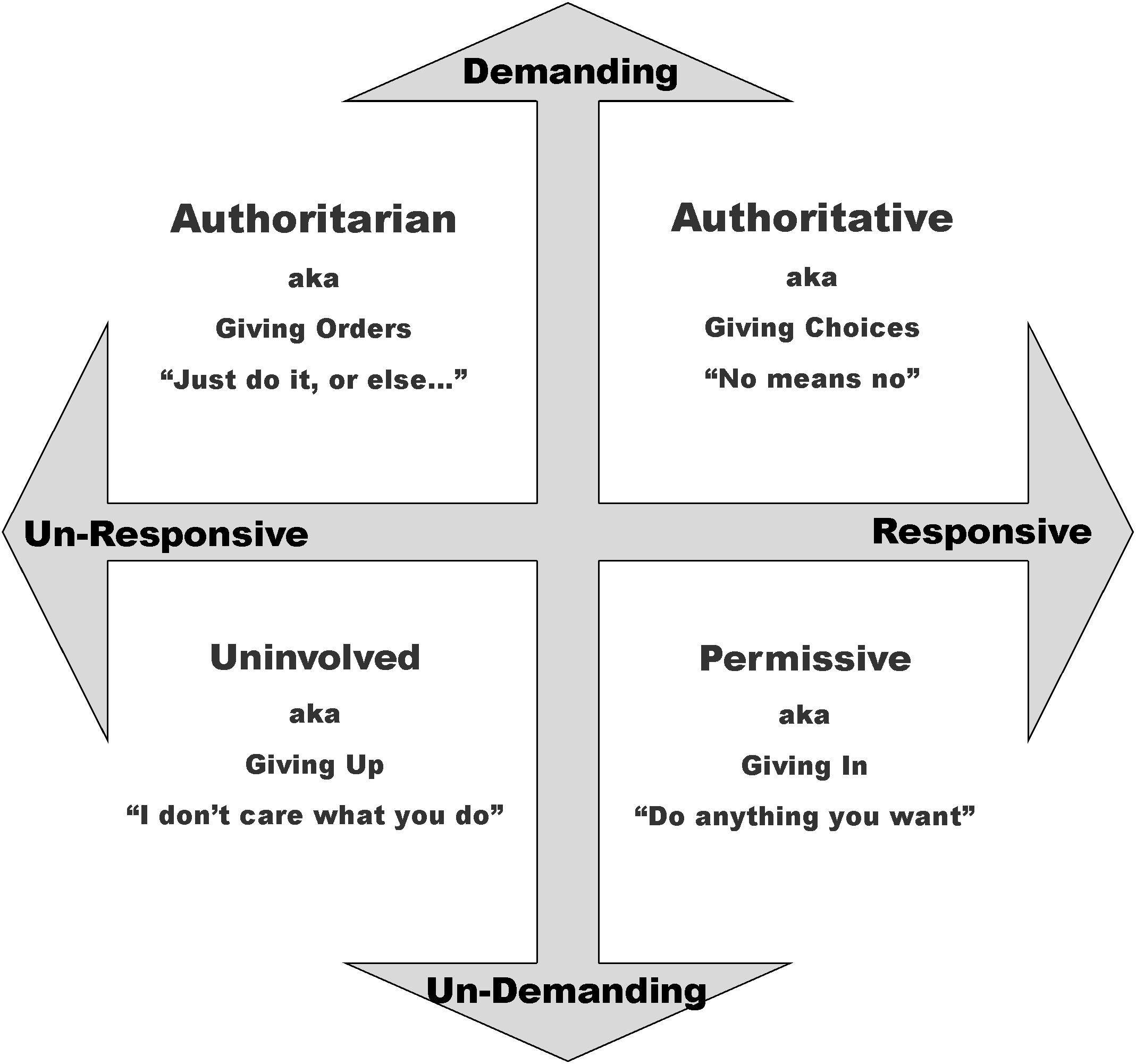
Parenting styles are put into four categories, permissive, authoritative, uninvolved, and authoritarian. Each category has a different level of demandingness along with responsiveness, and each parenting style will ultimately cause a child to develop in a certain manner. For example, children with authoritarian parents connect approval with love since they’re always looking to please their parents. On the other hand, children whose parents are permissive, often have too much freedom from their parental figures often have trouble with behavior management as they grow up. Parents who use an uninvolved approach don’t care enough will cause their children to have trust issues carrying into adulthood and often will feel a sense of neglect. Finally, children with authoritative parents will have high self esteem due to being raised in a home where expectations were clear, making sense of confidence and security be felt.

Image result for 4 parenting styles chart responsiveness and demandingness"

Why Do Parents Parent The Way They Do?

There is always reasoning behind the decisions we make in life, especially parents. Parents have to make choices carefully and make sure that what they’re doing is right for the development of their child. A psychologist named Diana Baumrind explored a study on more than 100 preschool-age children. Many times not only is a child’s development contingent upon their parenting style, but the parenting style can also be a result of the child’s behavior. If a child is misbehaved and mischeifious, the parents will have to be more invested in disciplining the child than of an easy-going youngster. Parenting styles not only are based on the behavior of the child but many other factors. Culture, their own childhoods, social influences, and numerous more factors come into play.

https://www.123rf.com/photo_83695187_african-american-mother-talking-with-her-daughter-indoors.html

A Look Deeper Into the Effect of Different Parenting Styles 

Parenting styles are usually classified in four categories; authoritarian, neglectful, indulgent, and authoritative. An authoritarian parent is classified as one who are punitive and is likely to believe in the “spare the rod, spoil the child” rule. This parenting affects children in their early childhood by causing their child to lack some critical social and communication skills that are important to leadership. A neglectful parent is one who does not engage with their child at all and just let them live their life. Children of these types of parents tend to not follow rules because they never had to when growing up, and they tend to have some behavioral issues. Indulging parenting is a parent who is very tentative to their children and provide them with lots of warmth and attention. These types of parents have few rules and have the “anything goes” type attitude; most children feel as though their parents are more like friends than parents. Children of these parents are usually very creative but usually have little self control and few boundaries. The last parenting style that is known to be the best is authoritative. These types of parents encourage their kids to be independent but also set boundaries for themselves. Authoritative parents often discipline their children but not punish them too harshly. This parenting impacts the child a lot because as they grow older, these parents give them more freedom the older they get which allows the child’s social skills, self-control, and self reliance to be more developed than others.

What is the Best Parenting Style?

Loving single black mother hugging african daughter caressing cu

Babies don’t come with an owners manual, making it hard to appoint one parenting style as the “right” or “best” one. Especially with babies having their own personalities, disabilities, needs, so on and so forth, but there are a few styles that are known to be most efficient in raising children in a positive way. According to Joseph M. V., John J. (2008). Impact of Parenting Styles on Child Development, “good parenting is parenting that prepares children to meet the needs of the specific culture or subculture in which they live in.” Although it has been stated by Ronald E Riggio Ph.D. that the “gold standard” is authoritative parenting. I personally believe that I was raised through authoritative parenting. It’s the kind of parenting every parent should strive to use. The outcomes of this parenting as stated earlier in this blog give the child an advantage because they were well raised as kids. When I have children, I will definitely strive to use the authoritative parenting style.

https://www.dreamstime.com/loving-single-black-mother-hugging-african-daughter-caressing-cu-cuddling-caring-mom-embracing-supporting-girl-mum-kid-sincere-image136499417

HOW DO YOU, HOW DO YOU, HOW DO YOU SLEEP? BABY SLEEPING – EXPLAINED.

As song artist Jesse McCartney’s 2008 hit “How Do You Sleep?”asks, how do you sleep? How do some babies sleep so easily and others it’s like pulling teeth? How do parents sleep when their baby is up all night?

“How Do You Sleep” by Jesse McCartney

If you have children of your own, think back to when they were babies. Did they sleep well? Did they sleep differently depending on the child? If you don’t have children of your own, think of stories you’ve heard about your infant year. For me personally, at 19 years old my parents will still bring up how much of a horrible sleeper I was. They’d have to drive around for hours at night to try and get me to fall asleep. Many nights my parents would take turns sleeping on the floor of my nursery, as it was the only way I’d fall asleep, of course it would only work a percentage of the time. My mom swears it’s because I’ve had “fomo” – (fear of missing out) since I was born. But who knows the real reason? Doctor’s couldn’t give her a straight answer. 

How Are Parents Affected?

Babies not sleeping well not only effects the babies themselves, but also the adults in their lives. Life will be chaotic the first few months of parenthood. Simply stated, if the baby isn’t sleeping, neither is at least one of their parents. A parent has to stay awake with the baby and try to comfort it and get it back to sleep. Often times the mother has to get up to breastfeed her newborn every 2-3 hours. Parents need to make their sleep the next priority right after their child. Napping while the baby naps, ordering a pizza instead of preparing dinner, keeping the house tidy not immaculate, are all little things to make parents a little less miserable/exhausted.

Baby Sleep Patterns & Conditions:

Babies should always be put to sleep on their back or side, NEVER on their stomach.  A firm sleeping surface, with nothing else in the crib as well as a pacifier if necessary.

SLEEP BY AGE:

0-3 Months
Newborns sleep on and off through the day and night, but he total sleep varies from baby to baby. It can be from around 8 to 18 hours a day. Typically, babies this young will only sleep for short periods of time as they need to be changed and fed regularly. Newborns are also very light sleepers, they spend more than half of their sleeping time in active sleep. They have yet to understand the day and night concept yet that adults follow where they are awake when it’s lights out and sleep when it’s dark outside. This doesn’t happen until about 6 weeks.

3-6 Months
Babies at this age might have 3 daytime naps of up to 2 hours each. Most will sleep 14-15 hours of sleep in total a day, with some babies sleeping up to 8 hours at night. The amount of active sleep starts to reduce, and they begin to enter quiet sleep at the beginning of their sleep cycles. But they still tend to wake up at least once during the night.

6-12 Months
From about 6 months old, the baby’s sleep patterns are more like yours. At this age, babies sleep an average of about 13 hours in total a day. They tend to sleep the longest period at night, averaging about 11 hours. Your baby will start dropping their number of daytime naps to about 2. Their naps are usually about 1 to 2 hours. In general, babies may wake up less frequently during the night because they don’t need to be fed as often. Most babies will wake only once during the night and need settling back to sleep. Some will still wake up more often. At this age, babies may start to worry about being away from their parent or caretaker. This may make it longer for babies to fall asleep and may temporarily increase night waking’s. Regular daytime and bedtime routines may help your baby to fall and stay asleep.

After 12 Months
As babies get closer to their first birthday, babies tend to sleep longer, wake up less often, take a nap once or twice during the day and sleep more at night. By the time they turn one year old, babies are likely to be sleeping 8 to 12 hours a night, waking only once or twice in that time.

RESTLESS BABIES

There are many reasons that a baby could only stay asleep for an hour at a time. Sometimes it’s the fact that the baby isn’t being stimulated enough throughout the day or is having too mellow of days, other times it’s the baby just wants to keep playing, or maybe the baby is just too interested in what they’re missing out on. It could also be the baby is under or over tired or suffering from separation anxiety. Whatever the cause of the baby’s restless behavior is, it is extremely frustrating for exhausted parents to cope with

SOLUTIONS:

Start a Routine: 
By following a nightly routine, the baby will know it istime for bed when you start that routine. A typical routine would be giving the baby a bath, putting them in pajamas, reading them a story in a rocking chair, then putting them down to sleep. Just as important as the routine is following an early bedtime. For babies, their melatonin levels rise around sundown so putting them to bed early makes it easier for them to fall asleep.

Naps, Naps, Naps:
An overtired baby is just as hard to put to sleep as an under-tired baby. Make sure the baby is napping consistently so they aren’t cranky when it’s time for bed. Babies before 4 months old don’t have the energy to stay awake for more than a couple hours at a time.

Cry it Out:
When the baby first wakes up in the middle of the night try to let them work it out themselves. Intervening each time will create a pattern and then the baby will not learn to put themselves back to sleep without you comforting them.

Don’t Feed the Baby to Sleep:
While this is OK for newborns, feeding the baby to sleep after they’re 4-5 months old is detrimental to their sleeping patterns. Anytime they wake up during the night they will think it is time for feeding.

WE ALL NEED IT

We’ve all heard a parent complain about how much their teenager sleeps but like babies, teenagers going through puberty need there z’s just as much! While babies need much more sleep than adults because of rapid physical, mental, and brain development. Newborns will sleep an average of 10-18 hours per day whereas the average adult will only sleep around 7 hours. Sleeping also allows humans to replace needed chemicals in our brains as well as give our body the “recharge” we need, making it just as important through adulthood. Despite sleep being essential to our lives, studies show it tends to be the first thing teens and adults will deny themselves of. Whether studying for a test, working extra shifts, or socializing, sleep comes second to most.

Design a site like this with WordPress.com
Get started